

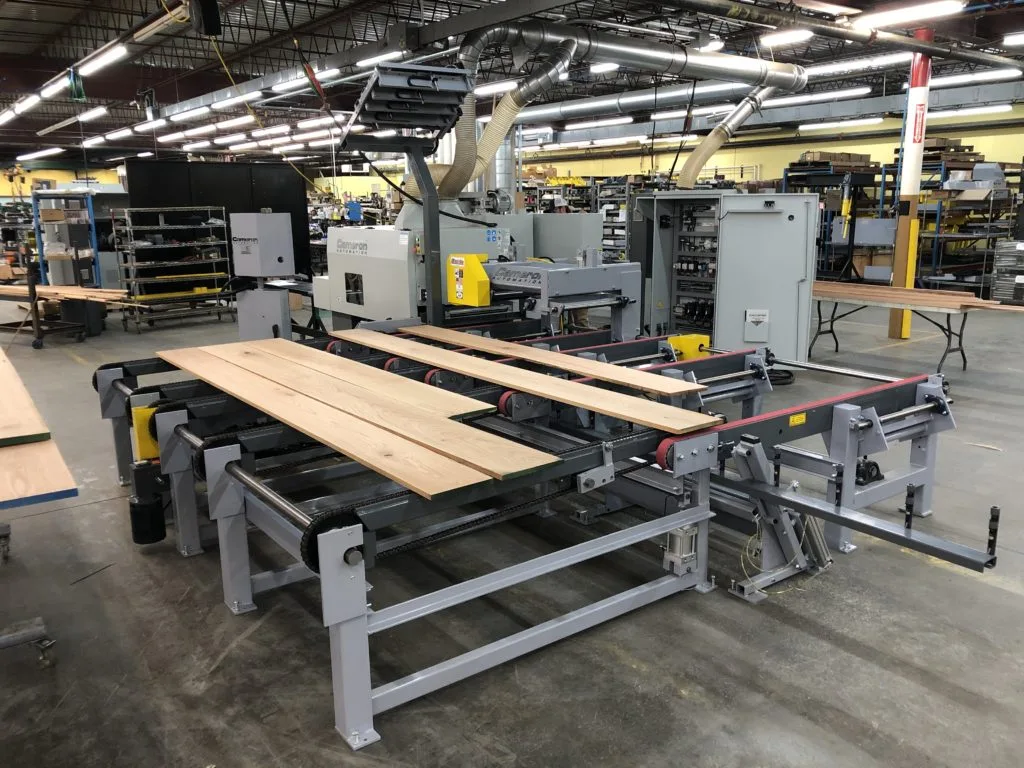
Cameron Automation #415A-AOR – The Automated Opti-Rip (Gang)
Overview
The Automated Opti-Rip rip saw optimization system is very adaptable to many material handling systems. Some of our systems are fed manually from a scissor lift of planed lumber. Some systems have a landing deck and are fed from the outfeed conveyor of a planer and some systems are fed by destackers and singulation machines.
Adaptable to many Material Handling Systems
(1) Operator Runs Whole Process from Bundle Dumper through to Rip Saw
Same Industry Leading Features of the Cameron Quick Rip for High Yield and Accuracy
Compatible with all 24″ & 40″ Fixed saws, and most Moving Arbor Saws on the Market
Cameron Saw Models:
#413A – 12″ Wide (2) Moving Blade, Multiple Fixed Blade Saw
#413B – 18″ Wide (3) Moving Blade, Multiple Fixed Blade HD Rip Saw
#413C – 24″ Wide (4) Moving Blade, Multiple Fixed Blade HD Rip Saw
Specs
Those who currently have mid sized ripping operations
Customers Looking to Automated the front end of their Rough Mill
A fixed arbor gang saw 24″ to 40″ wide
Production rates between 10,000 and 21,000 bd. ft
Current Installation Production Rates
Minimum = 10,000 bd. ft. per Day
Maximum = 18,000 – 21,000+ bd. ft. per Day
Minimum = 10,000 bd. ft. per Day
Maximum = 18,000 – 21,000+ bd. ft. per Day
Max Production
Typically Includes Material Handling Upstream from Rip Process
Typically Includes a Material Handling Outfeed System
(1) Operator Manipulating whole Infeed System (De-Stacker, Board Singulator, Automated Opti-Rip)
Outfeed Chains to Catch Rips and Cross Transfer
(1 – 2 ) Operators pulling Material from the Chains into Carts
(10 – 12+) 10 Ft. Long Boards per Minute on Moving Blade Saws
(16 – 18+) 10 Ft. Long Boards per Minute on Fixed Arbor Saws
Typically Includes Material Handling Upstream from Rip Process
Typically Includes a Material Handling Outfeed System
(1) Operator Manipulating whole Infeed System (De-Stacker, Board Singulator, Automated Opti-Rip)
Outfeed Chains to Catch Rips and Cross Transfer
(1 – 2 ) Operators pulling Material from the Chains into Carts
(10 – 12+) 10 Ft. Long Boards per Minute on Moving Blade Saws
(16 – 18+) 10 Ft. Long Boards per Minute on Fixed Arbor Saws
Lumber Length Capacities
Standard Machine: 5 Ft. Minimum / 16 Ft. Maximum
Short Stock Machine: 42″ Minimum / 16 Ft. Maximum
Standard Machine: 5 Ft. Minimum / 16 Ft. Maximum
Short Stock Machine: 42″ Minimum / 16 Ft. Maximum
Thickness Tolerances
12″ Saw Blades: 2.5″
14″ Saw Blades: 4″
12″ Saw Blades: 2.5″
14″ Saw Blades: 4″
Maximum Width (Incoming Material)
24″ Wide Model = 22″ Wide
40″ Wide Model = 38″ Wide
24″ Wide Model = 22″ Wide
40″ Wide Model = 38″ Wide
Yield Improvement over Hand feeding
Increased Safety for Operator
Full Production Tracking that includes:
Production Tallies
Rough Lumber tracking by length and Yield
Production Tallies
Rough Lumber tracking by length and Yield
Arbor Optimization (mainly used with large fixed arbor saws)
Bundle reports on packs of lumber
Simulation capabilities to simulate jobs before the wood ever hits the infeed
Product Value Decisions: software can choose rip widths based on which rips are more profitable for your company.
Explore More New Equipment Listings on Equipt
Browse related New Rip Saws, Other Saws, Saws (Woodworking), and Woodworking equipment, including CAMERON AUTOMATION machines for sale on Equipt.
New Equipment for Sale in Tennessee, United States
Find New Rip Saws, Other Saws, Saws (Woodworking), and CAMERON AUTOMATION equipment for sale in Tennessee, United States, with related local Woodworking searches.
New Equipment for Sale in United States
Browse New Rip Saws, Other Saws, Saws (Woodworking), and CAMERON AUTOMATION equipment for sale across United States, including related Woodworking inventory paths.
Sell Your Used Equipment
Find dedicated pages to sell used Rip Saws, Other Saws, Saws (Woodworking), Woodworking, and CAMERON AUTOMATION equipment on Equipt.