

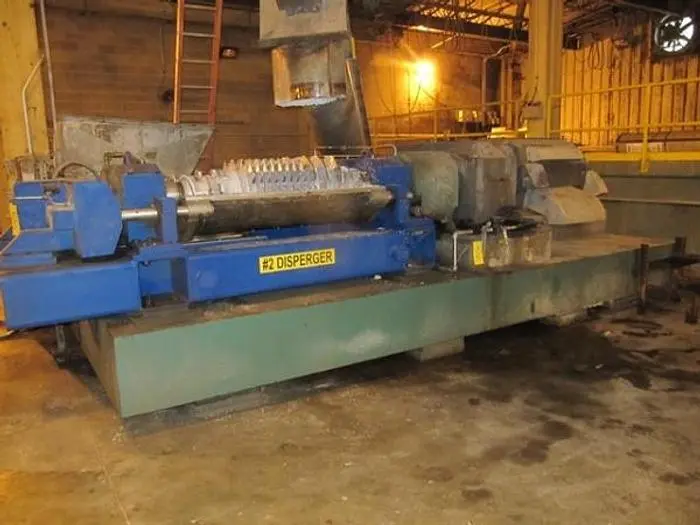
Ahlstrom Kamyr Kneader Disperger
Overview
Description
AndritzAhlstromMDR2000HotDispergerKneader
AHLSTROMMDRH200034"DISPERGER
Themechanicalagitatingdeviceusedinthepracticeofstep(c)is,forexample,adispersingdevice,suchasanMDR®disperserassoldbyAhlstromMachinery,oradeflakingdevice,suchasadeflaker-typepump,oranysimilardevicewhichagitatestheslurrytodisruptfiberflocsandreducecontaminantsizeandimprovecontaminantdistribution.
Also,toprovideatreatedfibrousmaterialforsubsequentprocessing,itmaybebeneficialforthefiberseparator12toincludeotherequipmentsuchasafiber classifier,adispersionsystem,andakneadingsystem.Examplesofdispersionsystemsinclude:Krima(availablefromCellwood,CornerandFMW),Diskperser(availablefromGL&V),MicarProcessor,Diva(basedonConflo+HiPreheaterfluffer/steammixer.availablefromMetsoPaper/Fiber);Frotapulper(availablefromMoDoMekan),Triturator/KneadingDisperser(availablefromThermoBlackClawson,Lamort);Disperger(availablefromVoithPaper).Examplesofkneadingsystemsinclude:MDRKneader(availablefromAndritz-Ahlstrom),UltraTwin-Flyte(availablefromThermoBlackClawson),Kneading-Disperger(availablefromVoithPaper).
885kneadingzoneislongcomparedtodiskdispersionandcanbeeffectiveinimpartingcurlorentanglement.OneexampleofakneaderistheVoithSulzerKD-500kneadingdisperger(sotermedintheabove-referencedarticleofHostetter-kneadingcanbeconsideredasoneformofdispergingforthepurposesofthepresentinvention).TheAhlstromMDR®Kneadercanalsobeused.Anotherexampleofakneaderisprovidedin
2.2.Low
SpeedKneading
Lowspeedkneadingimpartsaratherprolongedmechanicaltreatment(someminutes)toalargemass
offibrousmaterialwithamoderateshearingeffect.Thisactionisrelatedtotherelativelywideinterbar
clearanceandslowrotation.Rotationalspeedsarenormally100–200rpm,withafewexceptionsat
higherspeed.Thedispersioneffectresultsmainlyfromfibre-to-fibrefriction(rubbingaction).In
general,low-speedkneadersaredevicesinwhichthepulpisfedinbyascrewandheldbya
dischargedoorasitistransferredunderpressurebetweenrowsoffingersonashaftandotherson
thestatorwall.
Kneadingtechnologyforlowspeeddispersionconsistsofequipmentwithasingle–shaft(
Erwepa,
Voith-Sulzer
,
Lamort-Fiberprep
,
Maule
),ortwoshafts(
Shinhama,Modomekan-Ahlstrom-Kamyr
),
speciallydevelopedforhotdispersionorresultingfromtechnologytransferfromstockmixers(
Micar
Black-Clawson
).AtypicalsingleshaftkneaderisillustratedinFig.6.
Variousdesignsareusedfordoubleshaftkneaders
The
Shinhama
low-speedkneader,illustratedinFig.7,hastwocounter-rotatingshafts,oneturningat
95rpm,andtheotherrotatingslightlyfasterat110rpm[30].Thedevicepreviouslycalled
"Frotapulper"(
Modemekan-Kamyr
),andcurrentlyreferredtoas"MDRKneader,"(
Alhlstrom-Kamyr
)
lookslikealow-speedkneader,butthetwoscrewscounter-rotatesynchronouslyataspeedof900-
1800rpm(intherangeoftheofhigh-speeddispersers).Thedevicecalled"Micar"(
Black-Clawson
)
runsatintermediatespeed(400-500rpm)[12].
Thedischargedoorcontrolsthevolumeofpulpinthedevice.Stockmovesthroughthedeviceata
ratherlowspeed.Differencesinstockvelocityarecreatedinsidethemachine.Thestocknearthe
rotorismovingatahighervelocitythanthestocknearthestatorwall.Inthedoubleshaftkneader,the
rotorsturninoppositedirectionscausingashearingeffectwhenthestockchangesitsdirectionof
movement).Thesedifferencesinvelocityinducethefiber-to-fiberfrictionandthedispersioneffect.
Agentlekneaderincludingdewateringequipmenthasbeenproposed[31]andisillustratedinFig.8.It
consitsof3cylinders.Atthefirsthalfofeachcylinder,ascrewbootsthestockforwardandatthe
latterhalf,thestockproceedsthroughkneadingblades.Whenthestockproceedsfromonecylinderto
another,therotationofshaftaltersviceversa.Inthethirdcylinderchemicalscanbeintroduced.The3
cylindersallowincreasingthekneadingtime.Eachcylinderisequippedwithasinglemotorpermitting
anindependentcontrolofeachofthemsothatitispossibletoadjusttheunittoavariationofstock
and/ortargetqualityofthepulptobeproduced.Inthiskindofdevice,nosteamintroductionis
requiredasthetemperaturecanreachspontaneous50to90°Cduetothefrictioninvolvedinthe
kneadingparts.Theenergyconsumptionisbetween40and80kWh/T.Themaindifferencewiththe
otherlow-speedkneaderisthepresenceofdewateringzoneinthefirstandsecondcylinder.Thi
operateattemperaturesupto150°C.Theseconditi
onswererequiredinboardmillsforasphalt
dispersion.
Forbothtypes,theenergyconsumptionisintherangeof35–100kWh/t,withtypicalindustrialvalues
intherange60-80kWh/t.Varioustechniquescanbeusedtoadjusttheenergyconsumption
dependingonthedeviceused.Theseapproachesincludeadjustingthepressureonthedischarge
door,gapbetweenrotorandstator,inletconsistency,etc.
Inthedeinkingplant,dispersioncanbecombinedwithbleaching.Bleachingchemicalscanbe
introducedattheheatingscreworattheinletofthedispersionunit,whichcanbeusedasmixeror
bleachingreactor.Dependingontheoperatingtemperatureandthedeviceused,retentiontimemay
ornotberequiredafterthedispersionunit.
Generallythepulpdischargedfromalow-speedkneaderdoesnotrequiredilutionandbleachingis
conductedatthekneadingconsistency.Thepulpcanbedischargedatoperatingconsistencyinsome
high-speeddispersersbutgenerallyadilutionisrequiredfordischarge.Inthiscasestoragefor
bleachingextensionisnotpossible.
4.DISPERSION
Varioustypesofcontaminantscanbedispersedbyusinghigh-speeddispersersorlow-speed
kneaders.Theseincludebitumen,waxes,stickies,specks,residualink,andhotmeltcontaminants
suchasbookbindingorcontainersealingglues.Dispersionofwet–strengthpaperisalsoreported
[71].
Itmustbebroughttotheforethatdispersingtreatmentinducesfragmentationoftheparticlessothat
theycannotbeseen.However,evenifthepulpseemstobecleaner,thesecontaminantsarestill
presentinthepulpbuttheyarenotvisible.Iftheyarenotremovedduringthenextstepoftheprocess,
someproblemscouldappearinsomecasesduringpapermakingandduringthefinaluseofthe
product
Atta
High-qualityprintoncoatedpaperswithinkshardenedbydryingcanalsocausespecks,whichresult
frombindingbetweenthepigmentandthecoatingmaterial.Recoveredpapers,whichproducethese
kindsofspecks,arealsoglossymagazines.PapersprintedbyunconventionalprocessessuchasUV-
curedinks[49]orsomegradesofmoderndigitalprintalsoinducespeckformation.
AlargerecyclingstudyofpapersfocusingonspeckleddeinkedpulpandUV-varnishedpapers
particularly,hasbeenperformedintheCentreTechniqueduPapier[50].
First,thespecksfromvariousoriginshavebeen
comparedregardingtheirdifficultytobe
dispersedbykneading.Trialswereperformed
99.9
Kneadingefficiency(%)
Resistantcoating
attheCTPdeinkingpilotplantwithalowspeed
kneader,whichisahotdispersionunit(TL0
from
Lamort
,20kg/hr).Resultsfromresistant
coatedpapersandUVvarnishedprintedpapers
arereportedinFig.12[50].
99
90
UVvarnish
Lowenergyissufficientfordispersionofspecks
fromresistantcoatedpapers.Withtreatmentat
currentindustrialenergyconsumption(60
kWh/t)thepulplookscleantothenakedeye.
Higherenergyconsumptionisnecessaryfor
dispersalofspecksfromUVvarnishedprinted
papers.Gooddispersioncanbeobtainedat
hightemperatureandwithhighenergy
consumptioninaslowspeedkneader.
Energyconsumption(kWh/t)
40
60
80
100
120
140
160
180
Pulpfromunprintedwastepapercontaminatedwith4
%ofapulpproducedbypulpingUVvarnishedprinted
papersor10%ofapulpproducedfromwaterresistant
coatedpapers(offsetprinting).Influenceofenergy
consumption.Pilotplanttrials(pulpconsistency32%,
temperature90°C).Efficiencyiscalculatedasspec
k
areareduction(speckslargerthan100µm).
Fig.12
Hotdispersionofspecksinalowspeed
kneader[50]
.
TheworkhasbeenfocusedonUV-varnishedpapers;kneadinganddispersinghavebeeninvestigated
aspartofthisstudy.Trialshavebeenperformedinpilotplantsofmachinerysuppliersinorderto
optimizethedispersionofvisiblespecks.PulpfortrialswasproducedatCTPbyblendingapulpfrom
unprintedpaperswith2%contaminatedpulp.ContaminatedpulpcontainedUV-varnishedprinted
paperspulpedfor20minat14%consistencyand50°Cwithdeinkingchemicals.Fig.13toFig.15
showresultsfromtreatmentofcleanpulpmixedwith2%UV-varnishcontaminatedpulp(
Unprinted
wastepaperincluding2%ofUVvarnishedprintedpapers.Particleslargerthan100µmwereconsidered.
Efficiencyiscalculatedasspeckareareduction)
.
Bothlow-speedkneadersandhigh-speeddispersersareefficientinreducingthesizeoflargespecks
asshownFig.13[51].
Influenceofenergy
consumption,
pulp
99.9
Dispersionefficiency(%)
consistencyandtemperatureonresultsintrials
performedwithanindustriallow-speedkneader
areshowninFig.14.Increasingpulp
consistencyandtemperatureimprovesthe
dispersionefficiencyofspecksfromUV
varnishes.Fig.15showstheresultsoftrials
performedwithahigh-speeddisperserfor
dispersionofspecksfromUVvarnishes[52].
Dispersionismoreefficientathightemperature
and,accordingtothemachinerysupplier,the
implementationofapostdeinkingstageis
recommendedforremovalofspeckparticles,
whichhavebeenbrokeninsmaller,floatable
particles.
Kneading
99
90
Dispersing
Energyconsumption(kWh/t)
406080100120140160180
CTPpilotplanttrialsonindustrialdevices.Specksfrom
UVvarnishes,onlyspeckslargerthan300µmare
considered.
9.Summary
Dispersiontreatmentisusedprimarilyasameanstoimproveappearancecharacteristicsby
disguisingthepresenceofcontaminants.Whenqualitylevelsachievedbycleaningandscreeningare
notadequateforaparticularproduct,additionaltechniquescanbeused,whichcanincludedispersion
ontheentirepulporonapartofit,afterfractionation.Theaimofadispersingtreatmentisto
disperse
contaminantstosuchanextentthattheirdetrimentaleffectsarereduced
.
Dispersionathightemperaturewasusedinitiallyto
dispersebitumen
whenrecyclingOCC,andlater
todisperseothercontaminantssuchaswaxandhotmeltglues
.
Forwhitegrades,hot-dispersionwasproposedtodisperse
hotmeltcontaminants
andto
improvethe
visualaspect
bydispersingresidualinkandspecks.
Inhigh-speeddisperser,allcontaminantsarereducedinsize.Theywerethenclaimedtoprotect
papermachinefromstickies.However,becausedispersiondoesnotremovecontaminants,but
dispersesthemintothepulp,itcancreatesomedetrimentaleffectssuchasdepositsonthepaper
machine.
Asaconsequenceoftheprogressmadeincleaningandscreeningefficiency,hotdispersion
hasbeenquestionedinthepaperandboardrecyclingunits
.
Inbrowngraderecycling,high-speeddisperseristhemostpopulartechniqueused.Theintensityofits
actionisdeterminedbythedesignofthedisc,theenergyinput(generallybetween40and80kWh/T),
temperature,residencetimeandthegapbetweenthediscs.Narrowdiscgaps,lowtemperatureand
highresidencetimeincreasethedispersingintensity(thatallowgooddispersiontobeachieved)but
alsoincreasethefreenessloss.
Fordeinkingapplication,thefutureofhotdispersionismainlyrelatedtotheimprovementofthe
deinkingefficiency.Bothhigh-speeddispersersandlow-speedkneadersareproposedforthe
improvementininkdetachment,mainlybeforepost-flotation.Varioushigh-speeddispersingandlow-
speedkneadingtechnologiesareproposedandthechoiceofthemosteffectivetypeisthesubjectof
debate.Acombinationofthevarioustechnologiesinordertocombinetheadvantagesofeachisalso
proposed.
Actually,aregainofinterestappearsonthe
developmentofpapermechanicalproperties
ofthepulp
duringthesestages.Undertypicalhigh-speeddispersingconditions,burstandtensilepropertiesare
enhanced,similartolowconsistencyrefining,butwithoutthefreenesslosscausedbycuttingin
refiner.Underhightemperatureconditions,fibrecuttingisfurtherlimitedinhigh-speeddisperser.
High-speeddispersionandlow-speedkneadingcanintroducecurlintothetreatedfibres.Low-speed
kneaderinducesmorehigherfibrecurl,mainlybecauseofhigherresidencetime.Thisaffectsthen
tearstrength,dimensionalstability,bulk,etc.
Newapplications,suchas
microbiologicaldecontamination,
byusingchemicalsinalow-speed
kneader,havealsobeenproposed.