

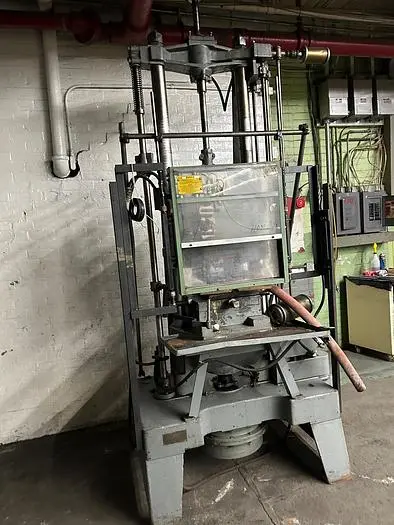
Drop Hammer #10 DA Pneumatic Double Action Gravity Drop With Z-80 Safety Gate
Overview
Description
Drop Hammer #10 DA Pneumatic Double Action Gravity Drop With Z-80 Safety Gate - Die striking, stamping, coin making & more!
This unit has a dual hammer action. Base is up-acting as the hammer comes down to create a perfect strike
Type #10 DA
Anvil weight Est. 250 LBS
Anvil opening 6"/6"
Die holder Upper work piece opening 4"/4"
The lower die, size 15"/15"
Approximate Net Weight: 6920 lbs
Equipped with
Z80 Pneumatic safety gate
Additional Workpiece holders as photographed
Pneumatically operated hand lever
About section
The Double Acting Air Power Drop Hammer is the most powerful machine in general for the production of commercial impression die forgings. medallions, and struck coins by impact pressure. Shortly after the First Industrial Revolution (about 1760) the steam hammer was developed. Then, in 1838, James Nasmyth of Scotland developed the hammer referred to as a double acting hammer in which steam or air pressure is applied to both lift the ram and also to drive it down with greater velocity than gravity alone. Such hammers can attain ram speeds up to 350 inches per second, although for stress and pressure design analysis a ram speed of 200 inches per second is used.
The basic construction of the hammer consists of a heavy anvil base, part of which is usually below round, which supports two frame members (columns) that accurately guide the vertically powered ram. The columns also support the cylinder in which the piston and piston rod is driven to operate and power the ram. The lower surface of the ram carries the upper die which contains the top half of the cavity, or impression, that shapes the forging. The lower die, which contains the remainder of the impression, is firmly wedged in place in the anvil by a driven key, as is the top die on the ram.