

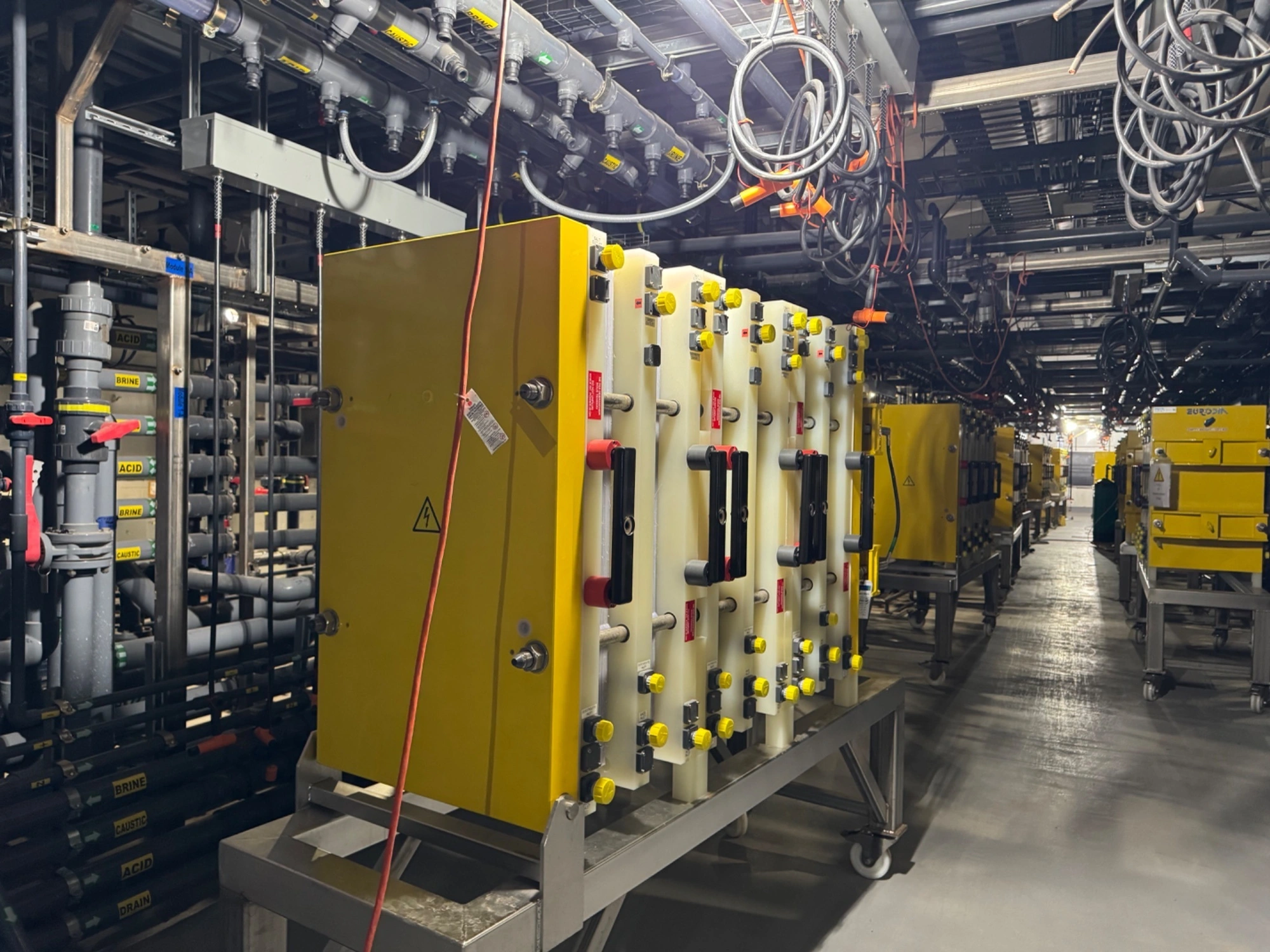
USED EURODIA EUR40C-360 BIP

Overview
Equipment Model : 18 × Bipolar Membrane Electrodialysis Stacks, model EUR40C-360 BIP
Cells per stack: 360 active "EUR40" cells per stack (6,480 cells across the full system)
Effective membrane area: 0.4 m² per cell, using Neosepta® bipolar, anion-exchange, and cation-exchange membranes with EUR40 spacers
Electrode assembly: 3 sets of electrode plates per stack (titanium/stainless-steel flat electrodes), 3 intermediate plates, 1 painted-carbon-steel clamping plate with yokes and hydraulic cylinders, 4 SS304 tie-rods per stack
Ancillary equipment supplied: 18 stack support trolleys, 11 automatic hydraulic pumps with control cabinets, 30 seaworthy shipping crates
Target output concentration: ≈4% HCl and ≈4% NaOH from the EDBM stacks (per the supply contract's guarantee schedule); the stack design can be pushed to 6%+, but the plant's control strategy uses that headroom sparingly because higher concentration accelerates membrane wear
Electrical rating (per stack): Warranted operating range of 270–350 V / 770–900 A; top rated capacity of 1,080 A / 350 V
Membrane life strategy: Standard membrane life is roughly 2 years; management plans to run the first two production "loops" at up to 1,080 A, which — combined with planned upgrades to the chelating (hardness-polishing) beds feeding the EDBM — is intended to extend membrane service life toward 3 years. Black & Veatch reviewed this approach and considers it sound.
Downstream concentration: Dilute acid and base exiting the EDBM are concentrated further by dedicated thermal systems: a 3-effect falling-film evaporator plus a pressure-swing azeotrope-breaking column brings HCl to a commercial 35.25%; a 4-effect forced-circulation evaporator brings NaOH to 50% (membrane grade)
Chloride impurity control: An added ion-exchange polishing step (KOCH resins, as used in the pulp & paper industry) reduces residual chloride in the NaOH product, which ranged 8–1,200 mg/L in Eurodia's own bench testing
Specs
Explore More Used Equipment Listings on Equipt
Browse related Used Reverse Osmosis Equipment, Water Treatment Equipment, Chemical Processing, and Processing & Packaging equipment, including EURODIA machines for sale on Equipt.
Used Equipment for Sale in New Jersey, United States
Find Used Reverse Osmosis Equipment, Water Treatment Equipment, Chemical Processing, and EURODIA equipment for sale in New Jersey, United States, with related local Processing & Packaging searches.
Used Equipment for Sale in United States
Browse Used Reverse Osmosis Equipment, Water Treatment Equipment, Chemical Processing, and EURODIA equipment for sale across United States, including related Processing & Packaging inventory paths.
Sell Your Used Equipment
Find dedicated pages to sell used Reverse Osmosis Equipment, Water Treatment Equipment, Chemical Processing, Processing & Packaging, and EURODIA equipment on Equipt.