

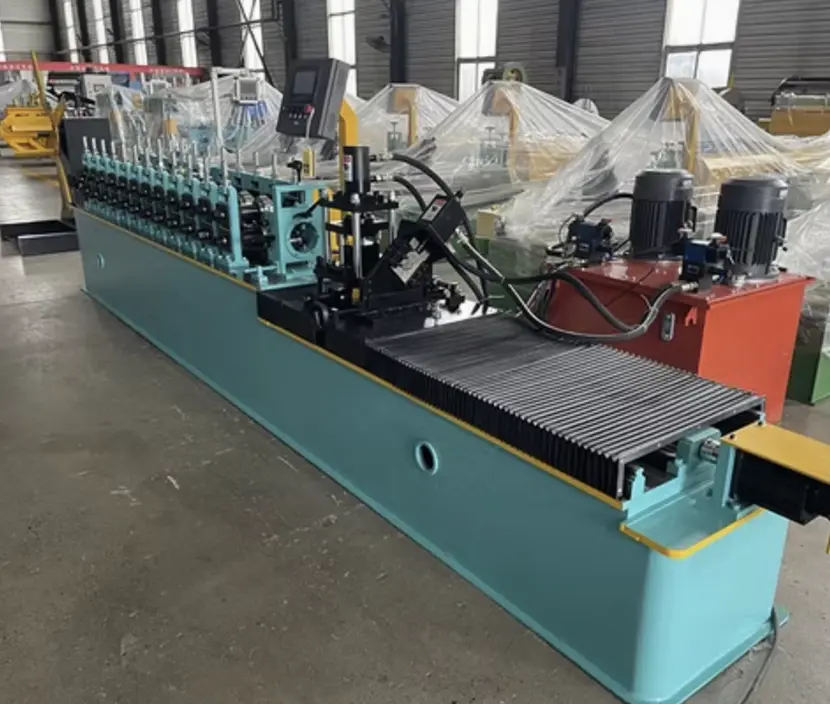
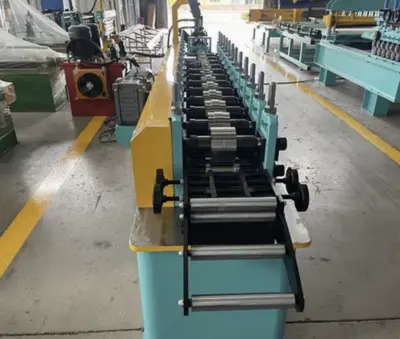

A stud roll forming machine is a specialized industrial machine used to produce steel studs, which are essential components in drywall framing and lightweight construction projects. The machine operates by passing steel coils through a series of rollers that shape the material into a predefined stud profile. These machines are designed to create precise, uniform, and high-quality studs for various construction needs.
Machine Description
A stud roll forming machine is engineered for durability and efficiency. It is ideal for producing standard and custom-sized studs used in partition walls, ceilings, and other structural applications. The machine typically handles a variety of materials, including galvanized steel, aluminum, and high-strength steel, to cater to diverse industry needs.
Key features of the machine include:
High Automation: Equipped with a PLC control system for seamless operation.
Customizable Profiles: Can produce different sizes and shapes of studs to meet specific project requirements.
Precision Engineering: Ensures dimensional accuracy and consistent quality.
Durable Build: Designed for long-term performance under industrial workloads.
User-Friendly Interface: Simplifies setup, operation, and maintenance.
Optional Add-ons
Hydraulic Punching System: For creating holes or notches as required.
Automatic Stacker: Streamlines the process of collecting finished studs.
Remote PLC System: Allows remote operation and monitoring.
Coil Car Tipper: Simplifies coil loading and handling.
Applications of Stud Roll Forming Machines
Residential Construction: Creating lightweight framing systems for walls and ceilings.
Commercial Buildings: Used in offices, shopping malls, and schools for partition walls.
Industrial Projects: Produces high-strength studs for load-bearing structures.
Setup and Installation Process
Unpacking and Placement: The machine is carefully placed on a level surface in the facility.
Electrical Connection: The machine is connected to the specified power supply.
Material Loading: Steel coils are loaded onto the uncoiler.
Calibration: Rollers and cutting systems are adjusted to the required profile size.
Trial Run: The machine undergoes a test run to ensure quality and performance.
Production: Once parameters are set, production begins at full speed.
Maintenance Requirements
Regular Lubrication: Ensure all moving parts are lubricated to prevent wear and tear.
Roller Cleaning: Clean rollers regularly to avoid debris buildup and ensure smooth operation.
System Checkups: Inspect the PLC, motors, and cutting systems for any faults.
Blade Sharpening/Replacement: Keep the cutting blades sharp for precise operations.
Safety Inspections: Regularly check all safety features to ensure operator safety.
Pricing
Stud roll forming machines in the USA are priced based on their features, automation levels, and production capacity. Entry-level machines may cost around $25,000–$40,000, while advanced models with additional features can go up to $100,000 or more.
Question and Answer Section
Q1: What material types are suitable for a stud roll forming machine?
A: The machine can handle galvanized steel, aluminum, stainless steel, and other lightweight metals.
Q2: Can the machine produce custom-sized studs?
A: Yes, most machines can be customized to produce a wide range of stud sizes and profiles.
Q3: What is the average production speed?
A: The production speed typically ranges from 20 to 50 meters per minute, depending on the machine model and material thickness.
Q4: Is training provided for machine operation?
A: Many manufacturers offer training sessions during installation to ensure operators are proficient.
Q5: How often does the machine need maintenance?
A: Regular maintenance, such as lubrication and roller cleaning, should be performed weekly. Comprehensive inspections should occur monthly.
Q6: Are there safety features included in the machine?
A: Yes, machines are equipped with safety guards, emergency stop buttons, and fault detection systems.
Q7: Can the machine integrate with existing production lines?
A: Yes, modern stud roll forming machines can be integrated into automated production lines for increased efficiency.
Roller Material: High-grade steel (e.g., GCr15) with heat treatment for durability
Material Thickness: 0.5 mm to 1.5 mm (customizable as per requirements)
Profile Sizes: Standard stud sizes (e.g., 2x4, 2x6) and custom dimensions
Frame Type: Heavy-duty steel frame for stability and longevity
Cutting System: Hydraulic or servo-controlled cutting for precise length adjustments
Machine Speed: 20–50 meters per minute (varies by model)
Power Supply: 220V/380V, 50Hz/60Hz, 3-phase
Control System: PLC with touchscreen interface for programming and monitoring
Material Type: Galvanized steel, aluminum, stainless steel
Safety Features: Emergency stop, safety guards, and fault detection systems
Optional Add-ons: Punching system, uncoilers, stackers, coil handling systems
