

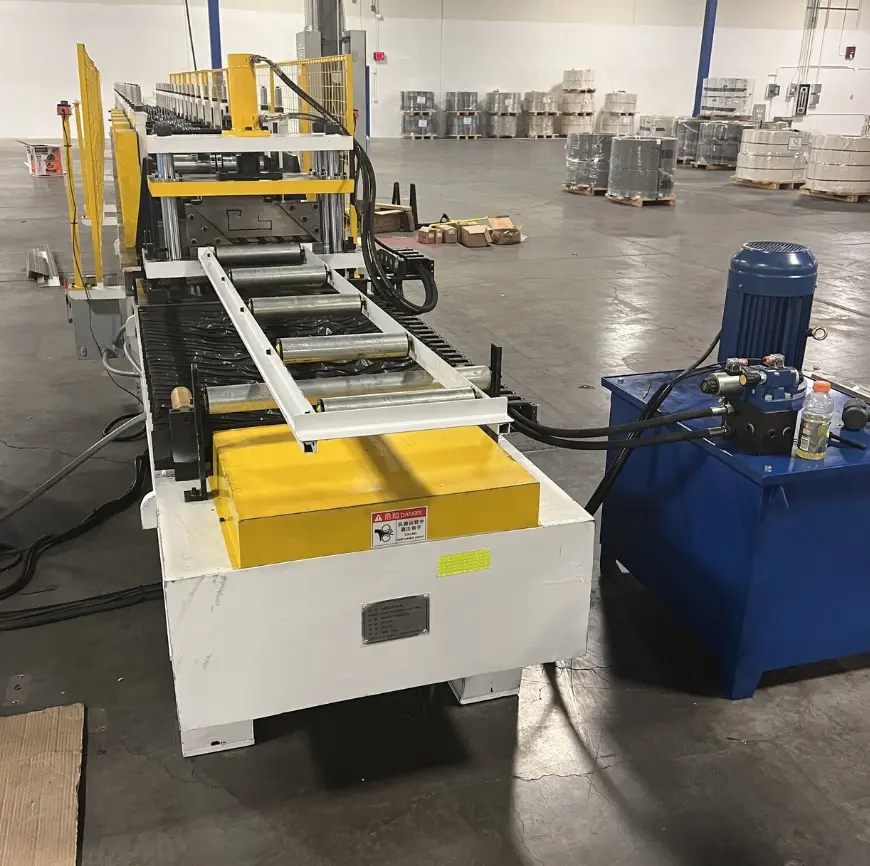
Metal Roof Fascia Roll Forming Machine USA

Overview
Description
Metal roof fascia roll forming machines are a crucial tool in the metal roofing industry, enabling manufacturers to produce precise fascia profiles that protect roof edges and enhance aesthetics. Designed for efficiency and accuracy, these machines cater to the increasing demand for durable, high-quality metal fascia products in the USA.
Machine Description
A metal roof fascia roll forming machine is an advanced piece of equipment designed to transform metal coils into fascia profiles with consistent accuracy and finish. These machines are built to handle a variety of materials, including galvanized steel, aluminum, and pre-painted steel, ensuring versatility across different construction projects.
Key features include high-speed operation, automated cutting, and a programmable control system that enables customization of profile dimensions. This machine reduces production time, minimizes material waste, and delivers high-quality profiles suitable for residential, commercial, and industrial roofing systems.
Common Applications
Residential Roofing Systems: Provides edge protection and a finished look.
Commercial Buildings: Offers durability and a sleek design.
Industrial Projects: Ensures long-lasting performance in demanding environments.
Setup and Installation Process
Machine Placement: Position the machine on a flat, reinforced surface.
Power and Hydraulic Connection: Connect the machine to the appropriate power supply and hydraulic system.
Material Loading: Load the metal coil onto the uncoiler.
Calibration: Set profile dimensions and material thickness in the PLC system.
Trial Run: Perform a trial run to ensure precision and adjust settings as needed.
Production: Begin full-scale production after successful calibration.
Maintenance Requirements
Daily: Clean rollers and check for debris.
Weekly: Inspect hydraulic systems for leaks and ensure blade sharpness.
Monthly: Calibrate rollers and check PLC settings for accuracy.
Yearly: Conduct a comprehensive inspection of motor systems and frame integrity.
Question and Answer Section
Q1: What types of materials can the machine process?
A1: The machine can process galvanized steel, aluminum, and pre-painted steel, with material thicknesses ranging from 0.4 mm to 1.2 mm.
Q2: How fast does the machine operate?
A2: The machine operates at speeds of 20-30 meters per minute, depending on the complexity of the fascia profile.
Q3: Can the machine be customized for different fascia profiles?
A3: Yes, the PLC control system allows customization for a wide range of profile widths and heights.
Q4: What safety features are included?
A4: The machine includes protective guards, emergency stop buttons, and an enclosed design to ensure operator safety.
Q5: What is the average power consumption of the machine?
A5: The main motor consumes 7.5 kW to 11 kW, while the hydraulic station requires approximately 4 kW.
Q6: Is on-site installation support available?
A6: Many manufacturers provide on-site installation and training support to ensure proper setup and operation.
Q7: What industries commonly use this machine?
A7: The machine is widely used in residential, commercial, and industrial construction for manufacturing durable and aesthetic roof fascia profiles.
Q8: Can the machine be upgraded with additional features?
A8: Yes, optional features such as automatic stackers, remote PLC systems, and advanced uncoilers can be added.
Specifications
Roller Materials:
High-grade chromium-plated steel for durability and precision.Heat-treated rollers for wear resistance.
High-grade chromium-plated steel for durability and precision.
Heat-treated rollers for wear resistance.
Frame Size:
Heavy-duty steel frame with a thickness of 16-20 mm for stability.
Heavy-duty steel frame with a thickness of 16-20 mm for stability.
Material Compatibility:
Galvanized steel, aluminum, pre-painted steel.Material thickness: 0.4 mm to 1.2 mm.
Galvanized steel, aluminum, pre-painted steel.
Material thickness: 0.4 mm to 1.2 mm.
Machine Speed:
Up to 20-30 meters per minute, depending on profile complexity.
Up to 20-30 meters per minute, depending on profile complexity.
Cutting System:
Hydraulic cutting system with carbide-tipped blades for clean, precise cuts.
Hydraulic cutting system with carbide-tipped blades for clean, precise cuts.
Power Requirements:
Main motor: 7.5 kW to 11 kW, 3-phase, 220V or 440V, as per USA standards.Hydraulic station: 4 kW.
Main motor: 7.5 kW to 11 kW, 3-phase, 220V or 440V, as per USA standards.
Hydraulic station: 4 kW.
PLC Control System:
Touchscreen interface with programmable logic controller (PLC) for easy customization.Brands: Siemens, Mitsubishi, or Delta.
Touchscreen interface with programmable logic controller (PLC) for easy customization.
Brands: Siemens, Mitsubishi, or Delta.
Profile Width and Height:
Adjustable width: 100 mm to 300 mm.Profile height: 20 mm to 50 mm.
Adjustable width: 100 mm to 300 mm.
Profile height: 20 mm to 50 mm.
Extras:
Uncoiler: 5-ton manual or automatic options.Recoiler: Optional for streamlined coil management.Stacker: Automated stackers for efficient profile handling.Remote Control System: Optional for off-site operation.
Uncoiler: 5-ton manual or automatic options.
Recoiler: Optional for streamlined coil management.
Stacker: Automated stackers for efficient profile handling.
Remote Control System: Optional for off-site operation.
Safety Features:
Protective guards and emergency stop buttons for operator safety.
Protective guards and emergency stop buttons for operator safety.