

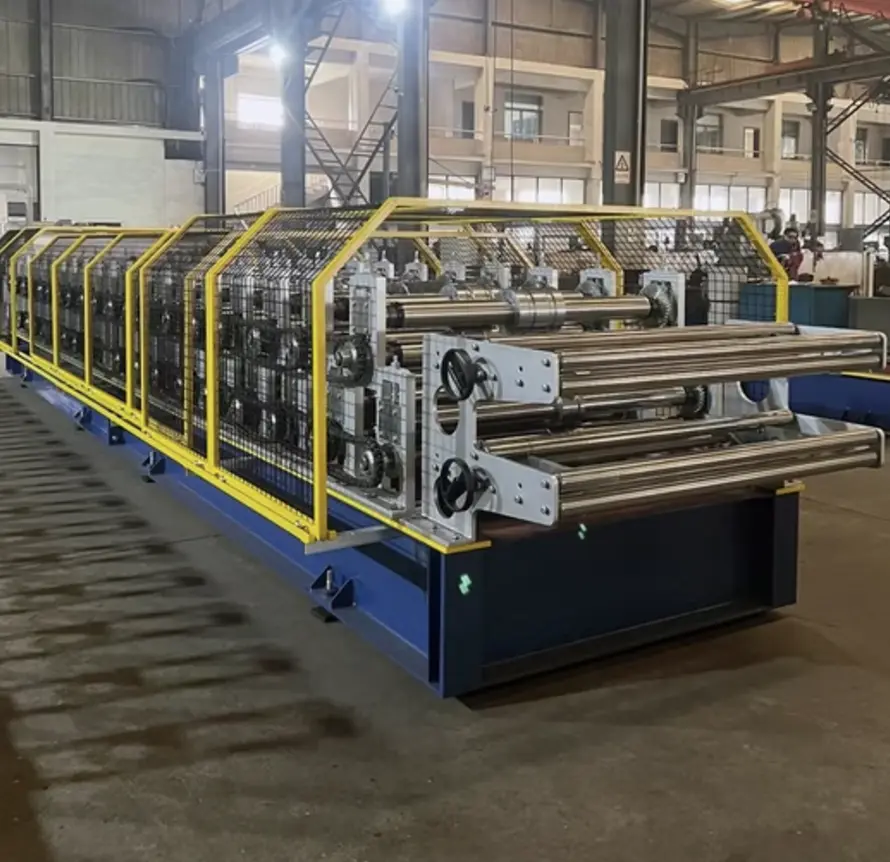
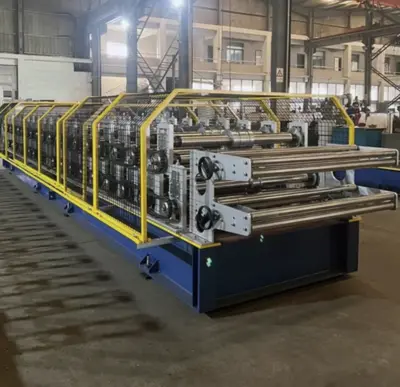
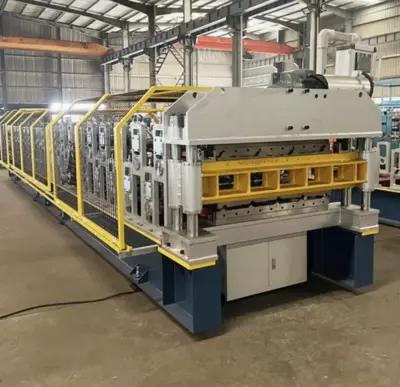
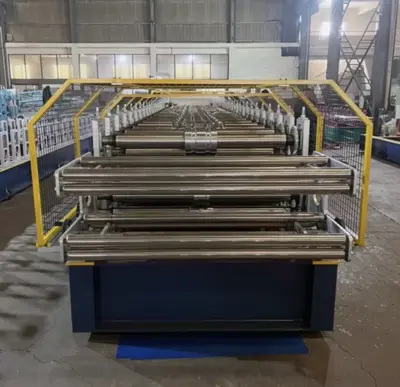
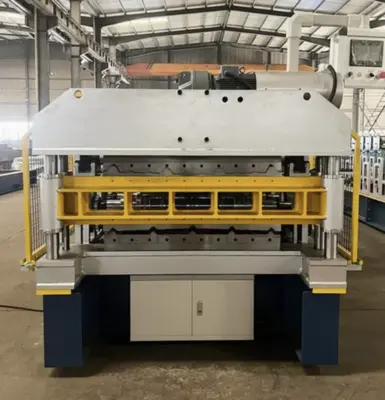

Commercial roll forming machines are essential in manufacturing components for commercial buildings, industrial setups, and large-scale infrastructure projects. These machines are designed to produce high-precision metal profiles like roofing panels, wall panels, structural sections, and various custom profiles efficiently and cost-effectively.
Full Machine Description
A Commercial Roll Forming Machine is a high-capacity machine used to form continuous metal sheets into desired shapes and profiles through a series of rollers. The rollers gradually shape the metal without compromising its structural integrity. These machines are capable of processing various metals such as steel, aluminum, and copper and are often customized to meet the specific needs of industries.
Commercial roll forming machines can cater to diverse industries, including construction, automotive, and energy sectors. Their applications span producing items like metal siding, floor decking, commercial roofing panels, and more.
Applications in Canada
Canada’s commercial construction sector heavily relies on roll forming machines for their ability to manufacture components such as:
Roofing Panels: Weather-resistant and lightweight roofing for industrial buildings.
Floor Decking: High-strength decking for commercial floors.
Structural Profiles: Beams, channels, and purlins for structural support.
Cladding Panels: Exterior and interior wall cladding.
Setup and Installation
Site Preparation: Ensure a level, spacious area with proper power connections.
Installation: Assemble the machine frame and connect the rollers, motors, and control systems.
Testing: Run test profiles to ensure accuracy and functionality.
Training: Provide operator training for efficient usage and maintenance.
Maintenance Requirements
Daily: Inspect rollers and clean debris.
Monthly: Lubricate moving parts and check hydraulic fluids.
Annually: Replace worn-out rollers and check for any electrical malfunctions.
Question and Answer Section
Q1: What materials can a commercial roll forming machine process?
A1: These machines can process materials like galvanized steel, aluminum, stainless steel, copper, and pre-painted steel, depending on the profile and industry requirements.
Q2: How does a roll forming machine ensure profile accuracy?
A2: The machine uses precisely calibrated rollers and a PLC-controlled system to maintain accuracy within ±0.5 mm, ensuring consistent quality.
Q3: Can the machine be customized for Canadian voltage standards?
A3: Yes, commercial roll forming machines can be tailored to meet Canadian voltage standards (typically 380V/50Hz or 600V/60Hz).
Q4: What industries in Canada commonly use these machines?
A4: Industries such as construction, infrastructure development, automotive manufacturing, and energy sectors frequently use roll forming machines.
Q5: How long does it take to set up and install the machine?
A5: Installation and setup usually take 1-2 weeks, including site preparation, assembly, and operator training.
Q6: Is it possible to produce multiple profiles with one machine?
A6: Yes, many machines come with interchangeable rollers, allowing for multiple profiles to be produced with a single setup.
Q7: What is the expected lifespan of a commercial roll forming machine?
A7: With proper maintenance, the lifespan of a commercial roll forming machine can exceed 20 years.
Q8: Are there any government incentives for buying roll forming machines in Canada?
A8: Various provincial and federal programs support manufacturing equipment investments; consult local trade authorities for details.
This comprehensive guide provides insights into the capabilities, applications, and considerations of commercial roll forming machines, making it a valuable resource for Canadian businesses exploring this technology.
Frame and Build
Frame Material: High-strength steelFrame Type: Welded or modular constructionCoating: Anti-rust and corrosion-resistant paint
Frame Material: High-strength steel
Frame Type: Welded or modular construction
Coating: Anti-rust and corrosion-resistant paint
Roller System
Roller Material: Chromium-coated steel for durabilityNumber of Stations: 10-25 roller stations (varies based on profile complexity)Roller Diameter: 80-120 mm
Roller Material: Chromium-coated steel for durability
Number of Stations: 10-25 roller stations (varies based on profile complexity)
Roller Diameter: 80-120 mm
Motor and Power
Main Motor Power: 15-30 kWHydraulic Station Power: 5-10 kWVoltage Requirement: 380V/50Hz or customized for Canadian standards
Main Motor Power: 15-30 kW
Hydraulic Station Power: 5-10 kW
Voltage Requirement: 380V/50Hz or customized for Canadian standards
Control System
Type: PLC (Programmable Logic Controller)HMI Interface: Touchscreen for user-friendly operationAutomation: Fully automated with manual override options
Type: PLC (Programmable Logic Controller)
HMI Interface: Touchscreen for user-friendly operation
Automation: Fully automated with manual override options
Processing Specifications
Material Thickness: 0.4 mm to 2.0 mmMaterial Width: 600 mm to 1,250 mmSpeed: 10-30 m/min (customizable)Cutting System: Hydraulic or servo-driven cuttingAccuracy: ±0.5 mm
Material Thickness: 0.4 mm to 2.0 mm
Material Width: 600 mm to 1,250 mm
Speed: 10-30 m/min (customizable)
Cutting System: Hydraulic or servo-driven cutting
Accuracy: ±0.5 mm
Extras
Optional Attachments: Automatic stackers, remote PLC systems, coil handling equipmentSafety Features: Enclosures, emergency stop buttons, and motion sensors
Optional Attachments: Automatic stackers, remote PLC systems, coil handling equipment
Safety Features: Enclosures, emergency stop buttons, and motion sensors
Dimensions and Weight
Machine Length: 8-15 metersMachine Width: 1.5-2.5 metersWeight: 5-10 tons (varies by machine size)
Machine Length: 8-15 meters
Machine Width: 1.5-2.5 meters
Weight: 5-10 tons (varies by machine size)
