

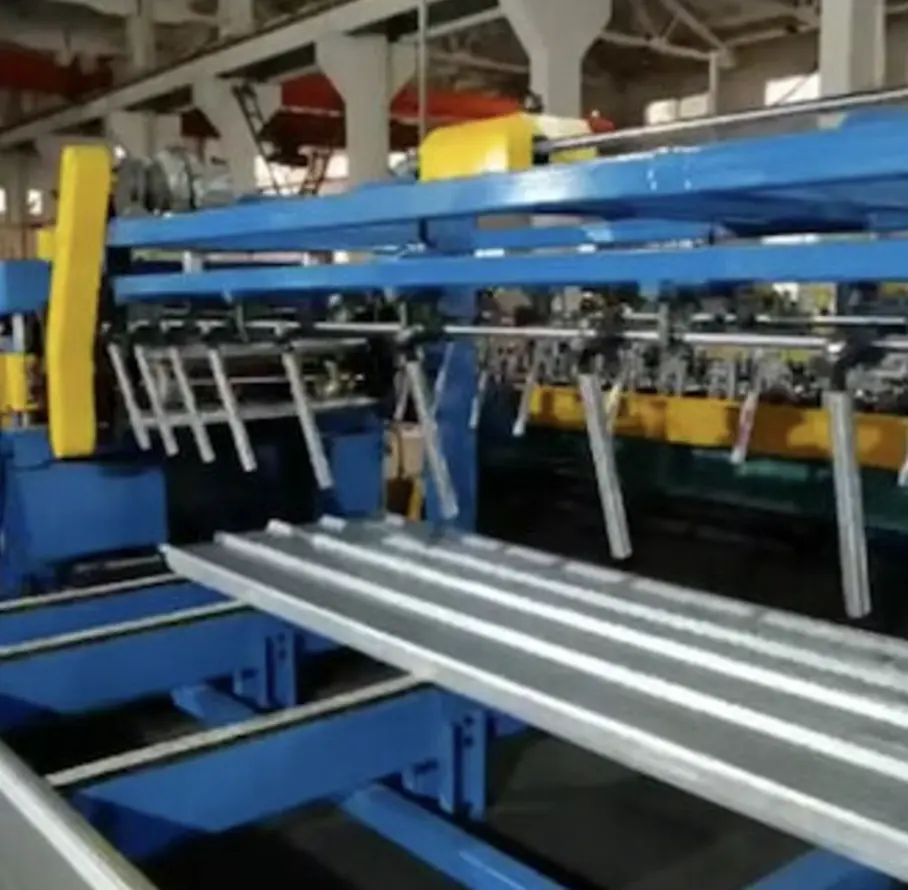
Roof and Wall Panel Stacker Machine Florida
Overview
A roof and wall panel stacker machine is an integral component of a roll forming production line, designed to streamline the stacking process of finished panels. These machines enhance efficiency by automating the collection and arrangement of panels after they are cut to size, minimizing manual handling and potential damage.
Description of Roof and Wall Panel Stacker Machine
A roof and wall panel stacker machine is engineered to handle various panel sizes and profiles efficiently. These machines are typically used in industries producing roofing and siding panels for residential, commercial, and industrial buildings. Their automation capabilities significantly reduce labor costs while ensuring uniform stacking and improved productivity.
Stackers are compatible with a wide range of roll forming machines and can handle panels made from materials such as galvanized steel, aluminum, and coated steel. They feature adjustable settings to accommodate different panel lengths, thicknesses, and profiles.
Benefits of Using a Roof and Wall Panel Stacker Machine
Enhanced Efficiency: Automates stacking, reducing manual labor.
Improved Safety: Minimizes handling, reducing injury risks.
Consistent Quality: Ensures uniform stacking for easy transportation and storage.
Customization: Adapts to various panel lengths, profiles, and materials.
Cost Savings: Reduces operational costs through automation.
Common Applications
Residential roofing and siding panel production
Industrial and commercial building panel production
Metal panel manufacturing lines
FAQs About Roof and Wall Panel Stacker Machines
1. What is the primary purpose of a roof and wall panel stacker machine?
The primary purpose is to automate the stacking process of finished panels, enhancing production line efficiency and reducing manual labor.
2. Can the machine handle multiple panel sizes?
Yes, it is designed to accommodate different lengths, widths, and profiles, with adjustable settings for flexibility.
3. What safety features are included?
Roof and wall panel stackers come with emergency stop buttons, safety guards, load sensors, and PLC-controlled automation to ensure operator safety.
4. How does the machine integrate with existing roll forming lines?
It seamlessly connects to the output conveyor of roll forming machines, with customization available for alignment and stacking based on specific production requirements.
5. Is the machine suitable for outdoor use in Florida's climate?
While the machine is designed for factory environments, weather-resistant options are available to withstand Florida's humid and coastal climate.
6. Can the stacker handle coated panels without damage?
Yes, the stacker is equipped with protective features, such as soft handling mechanisms, to prevent scratches or damage to coated panels.
7. What is the maintenance requirement for the machine?
Regular maintenance involves checking the motors, sensors, and moving parts. Lubrication and calibration ensure optimal performance.
8. Is remote monitoring available?
Yes, advanced models offer IoT integration for remote monitoring and diagnostics.
Specs
Material Compatibility:
Steel, Aluminum, Galvanized Steel, Coated SteelThickness: 0.3 mm to 1.2 mm (varies based on customization)
Steel, Aluminum, Galvanized Steel, Coated Steel
Thickness: 0.3 mm to 1.2 mm (varies based on customization)
Panel Lengths:
Adjustable to accommodate lengths from 2 meters to 12 meters (custom lengths available)
Adjustable to accommodate lengths from 2 meters to 12 meters (custom lengths available)
Stacking Speed:
Up to 30 panels per minute (dependent on the roll forming line speed)
Up to 30 panels per minute (dependent on the roll forming line speed)
Stacking Capacity:
Maximum stack height: 1.5 metersMaximum stack weight: 3 tons
Maximum stack height: 1.5 meters
Maximum stack weight: 3 tons
Automation Features:
Servo motor-driven stacker armsPneumatic or hydraulic lift systemsAutomatic alignment for uniform stacks
Servo motor-driven stacker arms
Pneumatic or hydraulic lift systems
Automatic alignment for uniform stacks
Control System:
PLC (Programmable Logic Controller) with HMI (Human-Machine Interface)Real-time monitoring and adjustment
PLC (Programmable Logic Controller) with HMI (Human-Machine Interface)
Real-time monitoring and adjustment
Safety Features:
Emergency stop buttonsSafety guards and enclosuresLoad sensors to prevent overloading
Emergency stop buttons
Safety guards and enclosures
Load sensors to prevent overloading
Power Requirements:
Voltage: 220V/380V/440V (customizable)Frequency: 50 Hz / 60 Hz
Voltage: 220V/380V/440V (customizable)
Frequency: 50 Hz / 60 Hz
Dimensions and Weight:
Varies based on model and custom configurations
Varies based on model and custom configurations
Optional Features:
Conveyor systems for seamless integration with roll forming linesAutomated wrapping or strapping systemRemote monitoring via IoT integration
Conveyor systems for seamless integration with roll forming lines
Automated wrapping or strapping system
Remote monitoring via IoT integration
Explore More New Equipment Listings on Equipt
Browse related New Stackers, Post-Press, Paper Equipment, and Material Handling equipment, including N/A machines for sale on Equipt.
Sell Your Used Equipment
Find dedicated pages to sell used Stackers, Post-Press, Paper Equipment, Material Handling, and N/A equipment on Equipt.