

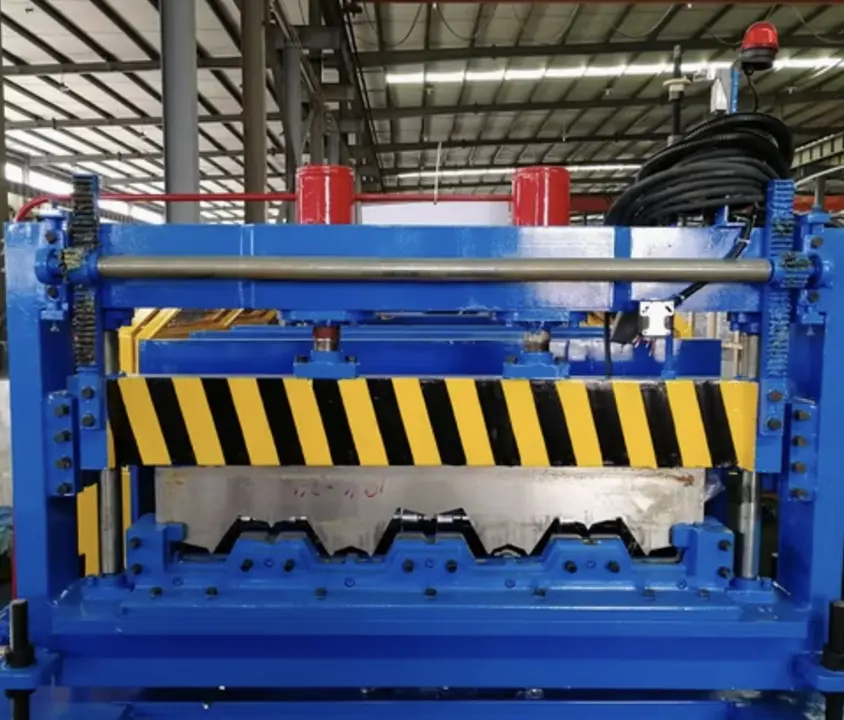
Commercial Metal Roof Decking Roll Forming Machine in the USA

Overview
Description
A Commercial Metal Roof Decking Roll Forming Machine is an advanced piece of equipment designed to manufacture roof decking panels that are widely used in commercial and industrial construction projects. These panels provide structural support, improve the load-bearing capacity of roofs, and act as a base for insulation or waterproofing systems.
This roll forming machine is built for precision and high productivity, ensuring seamless operations and high-quality output. It caters to the U.S. market's stringent construction and building code requirements, delivering panels with exceptional durability and weather resistance.
Key Features
High Speed Production: Capable of producing roof decking panels at speeds of up to 40-50m/min.
Durable Frame: Heavy-duty steel construction ensures machine stability and long operational life.
Precision Engineering: Incorporates advanced roller technology for uniform and accurate panel profiles.
Automated Controls: Equipped with a modern PLC system for automated production, monitoring, and fault detection.
Safety Measures: Includes safety guards and enclosures to protect operators and reduce workplace accidents.
Versatility: Suitable for producing a range of decking profiles, widths, and gauges.
Applications
Commercial Buildings: Used as structural support for roofs in warehouses, offices, and shopping centers.
Industrial Projects: Integral for factory sheds and industrial complexes.
Residential Projects: Occasionally used in high-end or large-scale residential structures for enhanced durability.
Question and Answer Section
Q1. What are the benefits of using a roll forming machine for roof decking?
Consistent quality and precision in panel profiles.
High production speed and reduced manufacturing costs.
Durable and weather-resistant panels suitable for the U.S. climate.
Ability to customize profiles and sizes based on project requirements.
Q2. Can this machine handle different material types?
Yes, the machine can process various materials, including galvanized steel, aluminum, and stainless steel, depending on the project's requirements.
Q3. What power supply is required for this machine in the U.S.?
The standard power requirement is 380V, 50Hz, 3-phase, but it can be customized to meet U.S. electrical grid standards.
Q4. How easy is it to switch between different profiles?
Switching profiles is relatively simple with modular roller dies and a PLC system. However, it may require downtime for reconfiguration.
Q5. What kind of maintenance does this machine require?
Regular lubrication of moving parts.
Inspection of rollers and dies for wear and tear.
Cleaning of hydraulic systems and PLC panels.
Scheduled servicing to ensure long-term reliability.
Q6. What is the typical lead time for machine setup and delivery in the U.S.?
Lead time ranges from 60-90 days depending on customization and shipping arrangements.
Q7. Are additional training and support available?
Yes, most manufacturers provide on-site installation, training for operators, and remote support as needed.
Specifications
Roller Materials: GCr15 or 45# steel, heat-treated for durability
Number of Stations: 16-24 stations (depending on the profile)
Material Width: 600mm - 1250mm
Material Thickness: 0.7mm - 1.5mm
Machine Speed: 40-50m/min
Frame Structure: 400 H-beam
Power Requirement: 380V, 50Hz, 3-phase or customized as per U.S. grid
Main Motor Power: 15-25 kW (depending on configuration)
Hydraulic Cutting System: Includes pre-shear and hydraulic cutting system
Control System: PLC with touch-screen interface
Cutting Accuracy: ±1.0mm
Profile Type: Wide rib, narrow rib, or custom designs
Extras: Automatic stacker, leveling system, remote PLC